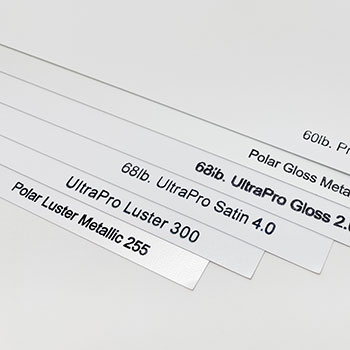
Red River Paper virtually invented the inkjet paper sample kit. We've offered samplers for over 25 years. In that time, we have tried every possible way of marking the sheets so our customers can easily identify the papers they like and need to purchase. Placing the label on the front of each paper creates the least amount of confusion, and helps to keep you the customer from being overwhelmed by a bunch of similar looking white sheets. Also, some papers cannot be stamped on the back as ink will not adhere to that side of the media.
As samples, we intend for these sheets to be printed so you can tell if you like them or not. While they can be used for production prints, we hope that you use them for testing purposes. Please note you can get a full trimmed 8x10 out of each sample sheet if you do not want the markings.
In the interest of full disclosure, we refer to the sample labeling in multiple locations along the path to purchase.
You can get a full trimmed 8x10 out of each sample sheet if you do not want the markings.
WHY DO YOU CHARGE FOR SAMPLES?
Simple - if we gave away the hundreds of kits we sell each month, the price of the paper you later buy would soon increase. The cost of each kit has to go somewhere, and we have found that our customers do not mind paying a few dollars to be introduced to our great products.
Related Posts and Information
Last updated: April 12, 2024
WHAT CUSTOMERS SAY ABOUT US
Very Impressed
I'll start by saying I am new to the whole printer game... and when you start learning things about paper.... LOL you'll quickly find out there is about a million and one types, weights, finishes, materials and so much more and to add on to that ICC profiles and printer settings is an entirely different world to figure out. I was excited when I found Red River because not only do they offer samples... but literally all the profiles and settings for the their paper. I started off with a build your own sample kit of 19 (you get 2 of each so 38 total) of their papers because who even knows what kind of paper you like when there are so many options.Needless to say I not a single one disappointed... so now I'm on to the greeting card sample kit because helllooo... why not... I purchased both the base and the expansion kit.. and obvi excited to play with them.ok now this is where it gets even better.... when I get home to my package the box is literally beat to h*** and looks like it has been soaking bucket of water for days.... SHAME ON UPS for handling peoples goodies like that.... so now I'm a little nervous because after all it is paper inside so I automatically assume it's ruined.WROOOOONNNGGG!!!! I don't know but by the grace of the paper and printing gods my cards are FLAWLESS.....so all this to say... Red Rivier has been so helpful in this printing journey because I haven't found many places that offer sample packs... hardly any companies offer printer settings or icc profiles.. the paper quality is top tier.... and the website offers so many resources. I have literally learned soooo much from everything that Red River offers.so thank you Red River... I was already planning to continue buying from you and this has just confirmed it 10 fold.
Papers with the Archival designtation can take many forms. They can be glossy, matte, canvas, or an artistic product. These papers are acid free, lignin free and can be made of virgin tree fiber (alpha cellulose) or 25-100% cotton rag. They are likely to have optical or fluorescent brightening agents (OBAs) - chemicals that make the paper appear brighter white. Presence of OBAs does not indicate your image will fade faster. It does predict a slow change in the white point of your paper, especially if it is displayed without UV filter glass or acrylic.
Archival Grade Summary
Numerous papers - made from tree or cotton content
Acid and lignin free base stock
Inkjet coating layer acid free
Can have OBAs in the base or the coating
Museum Grade Paper
Papers with the museum designation make curators happy. They are made from 100% cotton rag content and have no optical brightener content. (OBA) The base stock is acid and lignin free. The coating is acid free. This type of offers the most archival option in terms of media stability over time.
Museum Grade Summary
100% cotton rag content
Acid and lignin free base stock
Inkjet coating layer acid free
No OBA content
Photographic Grade Paper
Photo Grade products are designed to look and feel like modern photo lab paper. Most photo grade media are resin coated, which means they have a paper core covered by a thin layer of polyethelene (plastic) . Plastic gives the paper its photo feel, stability (flatness), water resistance, handling resistance, and excellent feed consistency.
Prints on photo grade media are stable over long periods. With pigment inks in a protected environment, you can see up to 80 years on-display life. All RC papers are Photo Grade for two reasons. Plastic content is not technically archival by museum standards. Also, the inkjet coating of all RC papers is slightly acidic. It facilitates instant drying and does not actually change the stability of your inks over time. Virtually all RC papers have optical brightening agents (OBAs).