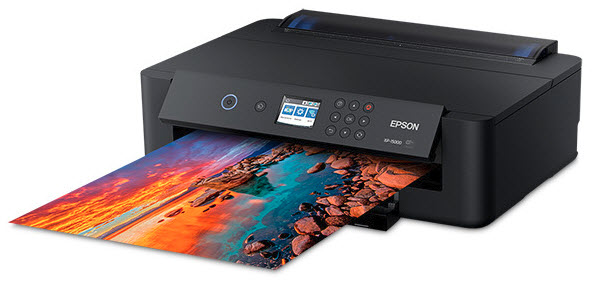
The Epson XP-15000 is a photo printer that uses six Epson dye based inks. Designed for the best possible color, saturation, and deep blacks, the XP-15000 is sure to please. Compatible with all inkjet papers, the XP-15000 performs its best with photobase glossy, satin, luster and photo metallic media. Matte and cotton fine art papers benefit from dye ink's universal compatibility and results with those papers are good. You would compare this printer to the Canon PRO-200S.
Paper Specs
The XP-15000 is compatible with all types of inkjet media from glossy to cotton fine art. A number of sizes can be printing without borders. The printer supports custom sizes within the range mentioned above. Two specialty paper paths are available for exotic and heavy weight media.
Sheets 4" x 6" up to 13" x 44"
CD printing
Top rear tray for heavier paper and card stock
Strengths
Excellent color reproduction using both color profiles and printer color management
Broad paper compatibility
Good print speed
Broad borderless size options
Auto 2-sided document printing
Wireless ready
Weaknesses
Neutral black & white is difficult to achieve
Heavy cotton and fine art papers (285gsm and up) are not recommended. The feed system will probably accept them but you are likely to encounter misfeeds.
Best Papers for the Epson XP-15000
Red River Paper offers a wide assortment of inkjet media in many sizes for the Epson XP-15000.
Street Price
Around $299 from most online retailers. Always check the manufacturer's website for potential rebates and special pricing offers.
Physical Dimensions
Printing: 18.7" x 30.9" x 16.2" (W x D x H)
Storage: 18.7" x 14.5" x 6.3" (W x D x H)
Weight: 18.7 lbs.
Ink Palette
Black
Cyan
Magenta
Yellow
Red
Gray
Borderless Sizes
4" x 6"
5" x 7"
8" x 10"
A4 (8.3" x 11.7")
8.5" x 11"
11" x 14"
11" x 17"
12" x 12"
13" x 19"
Connectivity
Hi-Speed USB 2.0 (1 port)
Wi-Fi CERTIFIED (802.11n only)
Related Posts and Information
Last updated: August 01, 2025
WHAT CUSTOMERS SAY ABOUT US
The best products
Polar Pearl Metallic and UltraPro Satin - they show my photos to their best advantage. The metallic provides the glow in special black and white prints while the satin makes you think you can feel the soft smooth texture of a person cheek in Portraits
Papers with the Archival designtation can take many forms. They can be glossy, matte, canvas, or an artistic product. These papers are acid free, lignin free and can be made of virgin tree fiber (alpha cellulose) or 25-100% cotton rag. They are likely to have optical or fluorescent brightening agents (OBAs) - chemicals that make the paper appear brighter white. Presence of OBAs does not indicate your image will fade faster. It does predict a slow change in the white point of your paper, especially if it is displayed without UV filter glass or acrylic.
Archival Grade Summary
Numerous papers - made from tree or cotton content
Acid and lignin free base stock
Inkjet coating layer acid free
Can have OBAs in the base or the coating
Museum Grade Paper
Papers with the museum designation make curators happy. They are made from 100% cotton rag content and have no optical brightener content. (OBA) The base stock is acid and lignin free. The coating is acid free. This type of offers the most archival option in terms of media stability over time.
Museum Grade Summary
100% cotton rag content
Acid and lignin free base stock
Inkjet coating layer acid free
No OBA content
Photographic Grade Paper
Photo Grade products are designed to look and feel like modern photo lab paper. Most photo grade media are resin coated, which means they have a paper core covered by a thin layer of polyethelene (plastic) . Plastic gives the paper its photo feel, stability (flatness), water resistance, handling resistance, and excellent feed consistency.
Prints on photo grade media are stable over long periods. With pigment inks in a protected environment, you can see up to 80 years on-display life. All RC papers are Photo Grade for two reasons. Plastic content is not technically archival by museum standards. Also, the inkjet coating of all RC papers is slightly acidic. It facilitates instant drying and does not actually change the stability of your inks over time. Virtually all RC papers have optical brightening agents (OBAs).