Inkjet Printer Ink Use Logs - Spreadsheets to Track Ink Usage
Track Your Ink. Save Money. Print Smarter.
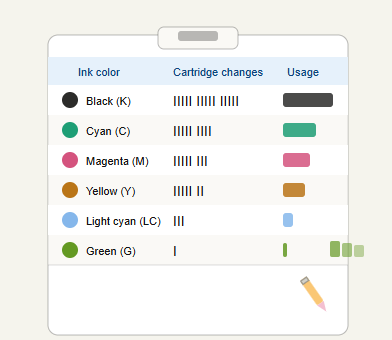
Running out of your most-used ink color — or finding a drawer full of green cartridges when you retire a printer — is more common than it should be. Our free Ink Use Log spreadsheets make it easy to stay ahead.
Red River Paper offers printable ink tracking logs for several popular inkjet printers, plus generic templates for four- and six-color machines. Every time you swap a cartridge, log it. Over time, you'll know exactly which ink colors you use most — so you can stock smart and waste nothing.
This is one great company.In the era of no customer service this company has excellent customer service and you can talk to an actual person. Their products are also excellent with superior results.I just can’t say enough good tings about this company.They also provide plenty of informative information about how to use their products.
Papers with the Archival designtation can take many forms. They can be glossy, matte, canvas, or an artistic product. These papers are acid free, lignin free and can be made of virgin tree fiber (alpha cellulose) or 25-100% cotton rag. They are likely to have optical or fluorescent brightening agents (OBAs) - chemicals that make the paper appear brighter white. Presence of OBAs does not indicate your image will fade faster. It does predict a slow change in the white point of your paper, especially if it is displayed without UV filter glass or acrylic.
Archival Grade Summary
Numerous papers - made from tree or cotton content
Acid and lignin free base stock
Inkjet coating layer acid free
Can have OBAs in the base or the coating
Museum Grade Paper
Papers with the museum designation make curators happy. They are made from 100% cotton rag content and have no optical brightener content. (OBA) The base stock is acid and lignin free. The coating is acid free. This type of offers the most archival option in terms of media stability over time.
Museum Grade Summary
100% cotton rag content
Acid and lignin free base stock
Inkjet coating layer acid free
No OBA content
Photographic Grade Paper
Photo Grade products are designed to look and feel like modern photo lab paper. Most photo grade media are resin coated, which means they have a paper core covered by a thin layer of polyethelene (plastic) . Plastic gives the paper its photo feel, stability (flatness), water resistance, handling resistance, and excellent feed consistency.
Prints on photo grade media are stable over long periods. With pigment inks in a protected environment, you can see up to 80 years on-display life. All RC papers are Photo Grade for two reasons. Plastic content is not technically archival by museum standards. Also, the inkjet coating of all RC papers is slightly acidic. It facilitates instant drying and does not actually change the stability of your inks over time. Virtually all RC papers have optical brightening agents (OBAs).