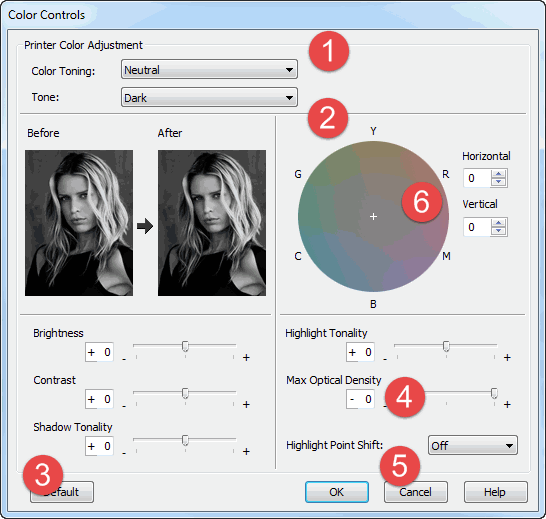
Epson's advanced black & white feature is fairly easy to use and offers many fine adjustment opportunities. You can use this feature with color or grayscale images. Because there is no way to accurately preview the final output, you will need conduct a few trials before getting comfortable with the setup. We suggest making a number of test prints with different settings (and make lots of notes!). Your subject matter, shooting style, and file type/quality all play a part. However after some practice, you will know what to expect from certain image types and setting combinations.
Color Toning - Available settings are Neutral, Cool, Warm, and Sepia.
Tone - Changes the entire tonal scale of an image. Epson recommends that the Dark setting may be best.
Shadow & Highlight Tonality - Control the grayscale tone specifically at the top and bottom of the scale.
Max Optical Density - Adjusts the focus of the overall print. Set the density lower for a softer print.
Highlight Point Shift - Helps to reduce gloss differential by adding some density to highlights. This setting would be for glossy and satin/luster papers.
Tone Color Circle - Pick specific color tone for your image.
Related Posts and Information
Last updated: October 05, 2019
WHAT CUSTOMERS SAY ABOUT US
Great products, great service and help.
I am relatively new to photography as a hobby, and enjoy printing and framing. the photography and printing part of my hobby was ok, but I quickly found out that taking a good picture is easy compared to getting that good photo printed. I was having trouble with the quality of my prints. I could never seem to get it right.I purchased a new printer, but still could never get the quality I wanted. After researching, I came across RR Paper. Their selections of papers are great, I ordered a sample kit, and was really impressed. They provide all profiles and give instructions on installing them. I highly recommend this company. Add together their products, service and technical help, and you have one great company. Thanks.
Papers with the Archival designtation can take many forms. They can be glossy, matte, canvas, or an artistic product. These papers are acid free, lignin free and can be made of virgin tree fiber (alpha cellulose) or 25-100% cotton rag. They are likely to have optical or fluorescent brightening agents (OBAs) - chemicals that make the paper appear brighter white. Presence of OBAs does not indicate your image will fade faster. It does predict a slow change in the white point of your paper, especially if it is displayed without UV filter glass or acrylic.
Archival Grade Summary
Numerous papers - made from tree or cotton content
Acid and lignin free base stock
Inkjet coating layer acid free
Can have OBAs in the base or the coating
Museum Grade Paper
Papers with the museum designation make curators happy. They are made from 100% cotton rag content and have no optical brightener content. (OBA) The base stock is acid and lignin free. The coating is acid free. This type of offers the most archival option in terms of media stability over time.
Museum Grade Summary
100% cotton rag content
Acid and lignin free base stock
Inkjet coating layer acid free
No OBA content
Photographic Grade Paper
Photo Grade products are designed to look and feel like modern photo lab paper. Most photo grade media are resin coated, which means they have a paper core covered by a thin layer of polyethelene (plastic) . Plastic gives the paper its photo feel, stability (flatness), water resistance, handling resistance, and excellent feed consistency.
Prints on photo grade media are stable over long periods. With pigment inks in a protected environment, you can see up to 80 years on-display life. All RC papers are Photo Grade for two reasons. Plastic content is not technically archival by museum standards. Also, the inkjet coating of all RC papers is slightly acidic. It facilitates instant drying and does not actually change the stability of your inks over time. Virtually all RC papers have optical brightening agents (OBAs).