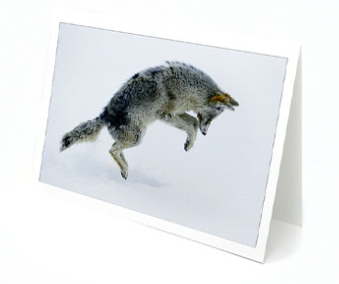
We get asked this question enough, it made sense to write an article about it.
Let's start with what paper makes a good greeting card:
High quality inkjet coating on one or both sides - single vs. double-sided
If single sided, the back of the paper has to be plain - able to accept text or light graphics
Able to be scored and folded without excessive cracking
Now let's look at why satin and luster papers are typically not available in greeting cards:
Satin and luster papers are almost always Resin-Coated (RC) papers
RC papers do not score easily
When folded, RC papers can crack
The back of single-sided RC papers is usually plastic
Single-sided RC papers cannot be printed on the back side
You can't write on back side
What does that leave us?
Greeting cards are almost never RC paper
Card stock that works must fold easily
Card stock must be double-sided or have a plain paper back for the inside of the card
What we DO have
We offer a line of high-gloss folded greeting cards called Pecos River Gloss. These use a different coating technology (called 'cast coating') that is softer, so its less prone to cracking when folding. It also has a plain paper backing, so that you can write or print the inside of the card.
Red River Paper offers your best options for inkjet printable greeting cards in a wide variety of sizes.
I spent forever looking for a good paper company that provided accurate information which I could easily understand. Red River Paper is the only company I purchase any high quality printer paper from now! Their website is easy to navigate, their descriptions are helpful in making purchases and their color profiles provide high quality prints time and again.
Papers with the Archival designtation can take many forms. They can be glossy, matte, canvas, or an artistic product. These papers are acid free, lignin free and can be made of virgin tree fiber (alpha cellulose) or 25-100% cotton rag. They are likely to have optical or fluorescent brightening agents (OBAs) - chemicals that make the paper appear brighter white. Presence of OBAs does not indicate your image will fade faster. It does predict a slow change in the white point of your paper, especially if it is displayed without UV filter glass or acrylic.
Archival Grade Summary
Numerous papers - made from tree or cotton content
Acid and lignin free base stock
Inkjet coating layer acid free
Can have OBAs in the base or the coating
Museum Grade Paper
Papers with the museum designation make curators happy. They are made from 100% cotton rag content and have no optical brightener content. (OBA) The base stock is acid and lignin free. The coating is acid free. This type of offers the most archival option in terms of media stability over time.
Museum Grade Summary
100% cotton rag content
Acid and lignin free base stock
Inkjet coating layer acid free
No OBA content
Photographic Grade Paper
Photo Grade products are designed to look and feel like modern photo lab paper. Most photo grade media are resin coated, which means they have a paper core covered by a thin layer of polyethelene (plastic) . Plastic gives the paper its photo feel, stability (flatness), water resistance, handling resistance, and excellent feed consistency.
Prints on photo grade media are stable over long periods. With pigment inks in a protected environment, you can see up to 80 years on-display life. All RC papers are Photo Grade for two reasons. Plastic content is not technically archival by museum standards. Also, the inkjet coating of all RC papers is slightly acidic. It facilitates instant drying and does not actually change the stability of your inks over time. Virtually all RC papers have optical brightening agents (OBAs).