By Michael MacEoghain
I've been printing for over 30 years, both in the darkroom and digitally, across virtually all major paper brands and many smaller ones. Whether in the darkroom or digitally, I've always found that printing brings me as much satisfaction as captur-ing the image itself. It's not just the final step; it's part of the creative expression, equal in importance to the photograph. In that time, I've come to appre-ciate that no single paper is perfect for everything, and that's part of what makes the world of fine art printing so rewarding: each paper brings out some-thing unique.
Back at the start of March, I reviewed Red River's Palo Duro Baryta Fibre 300. Compared to that paper, Big Bend Baryta feels just slightly more neutral in tone. While Palo Duro gets its bright white look from its barium sulfate coating, I've always felt it carries a subtle hint of warmth. Big Bend, on the other hand, leans closer to true neutral without losing vibrancy or depth.
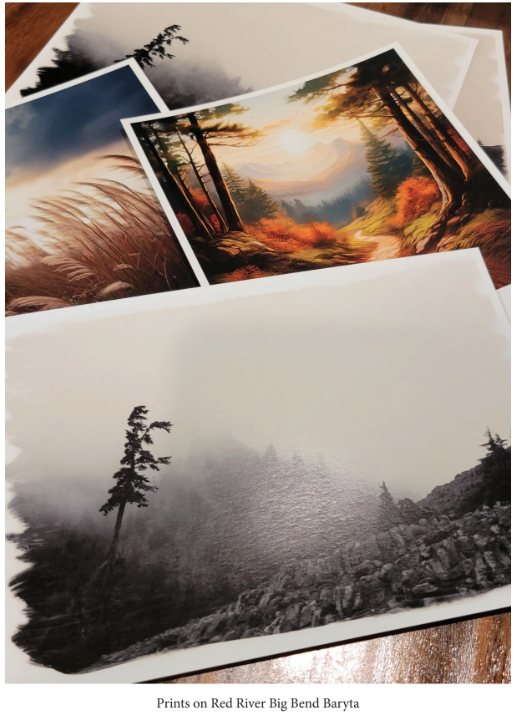
Big Bend is a 310gsm alpha-cellulose paper with a true baryta coating and a smooth satin finish. Satin finishes strike a balance, amplifying vibrancy and detail without the harsh reflections associated with gloss. As a result, photographs printed on baryta satin paper possess a unique liveliness, often feel more immersive and engaging, and give prints a substantial presence. With a wide color gamut and rich tonal range, this paper brings out deep blacks and smooth gradients, making it equally suited for both black-and-white and color photography. It delivers exceptional results with both color and black-and-white prints, rendering fine details, shadows, and subtle gradients with clarity and grace. Despite its heavier weight compared to Palo Duro, I've found it prints fairly flat off the roll and is easy to handle.
I routinely print on Epson SC-P900 and SC-P5370 printers, as well as Canon PRO-2600 and PRO-4600 models; a wall of printers around my workstation! Big Bend performs beautifully across all of them. I've read occasional complaints online about curling, but in my experience, prints come off the roll in excellent condition with only minor curl and are easy to flatten. Sheet boxes stored upside down can help reduce post-print curl, and rolls should always be stored upright to maintain their shape.
As with any fine art paper, I can't stress the importance of wearing cotton gloves enough. It's a small detail that makes a big difference when handling high-quality media.
Another area where Red River consistently shines is in its ICC profiles. They're among the best I've used-reliable, accurate, and easy to integrate into a color-managed workflow. Of course, there's a right and wrong way to use profiles, and in the next issue of Gathered Light Magazine, we'll explore ICC basics and color management tips to help readers get the most from their papers and printers. Big Bend Baryta is also priced very reasonably for a baryta-coated alpha-cellulose paper, and it ships directly from Texas - an added bonus for North America-based photographers looking to reduce both cost and shipping time.
Whether you're just beginning to explore baryta papers or you've been printing for decades as I have, Big Bend Baryta offers a combination of quality, versatility, and value that's hard to beat.
Micheal MacEoghain is the founder of the Gathered Light ecosystem including Gathered Light Magazine.
Related Posts and Information
Last updated: June 07, 2026


