Resin coated (RC) photo paper is the most popular type of photo paper. It is available as a wet chemistry (darkroom) paper and inkjet paper. RC papers have a core of tree based paper coated on both sides with polyethylene resin, which is plastic.
Red River Paper offers a variety of RC photo papers:
- UltraPro Satin
- UltraPro Luster 300
- Arctic Polar Luster
- Polar Luster Metallic 255
- UltraPro Semigloss 255 Double-sided
- UltraPro Gloss
- Polar Gloss Metallic
This paper has a number of names:
- Resin Coated (RC)
- Photobase
- PE Base - Polyethylene Base
Summary
RC papers were developed in the later 1960's and became the dominant type of photo paper used in the 1970's and onward. They are able to withstand handling and the environment well. RC papers can have glossy, satin, luster, and rarely a semi-matte surface. RC papers come in different weights and thickness. The typical RC paper is 10.4 mil. A mil is a thousandth of an inch. You will also find them as 7 mil, 8 mil, and 12 mil variants. Weights run from 170 gsm up to 310 gsm, which stands for grams per square meter. RC papers can be coated for printing on one or both sides. With papers that are coated on one side for printing, the back side cannot be printed. Ink will not dry and will run.
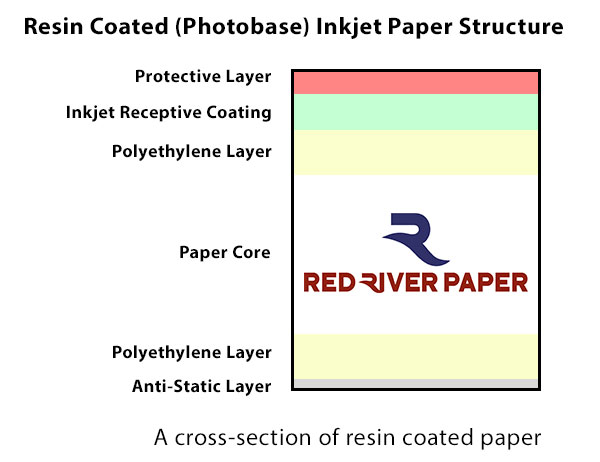
RC papers have the following structure, starting from the top surface:
- Protective layer - Not present on all RC papers
- Inkjet receptive layer - chemicals that trap inkjet ink and hold it in place
- Polyethylene layer
- Paper core - alpha-cellulose / tree based paper
- Polyethylene layer
- Anti-static coating - Not present on all RC papers
The Plastic Revolution Beneath Your Photos: A History of Resin Coated Photo Paper
For most of photography's long history, a photograph was printed on something that was, at its core, just paper. Refined and treated, but paper nonetheless. The journey from those humble fiber sheets to today's sleek, plastic-sealed RC paper is a story of chemistry, military necessity, commercial ambition, and the relentless human desire to get photos back faster. Whether you've printed in a darkroom or on an inkjet printer, the odds are overwhelming that resin coated paper (also called RC paper, PE paper, or photobase) is what you've been printing on. And yet most people have never given it a second thought.
To understand RC paper, you first need to understand what it replaced. For roughly the first century of photography, photo paper consisted of a plain fiber base, essentially high-quality wood-pulp paper, coated with a layer of barium sulfate, a white mineral compound known as baryta. This baryta layer served as a bright, reflective foundation upon which the light-sensitive silver halide emulsion was applied. The baryta coating gave the paper a whiter base, brightened the image, brought out the tones, and provided a stable ground for the emulsion. The results were beautiful, rich, and archival. Working with fiber-based (FB) paper, however, was a slow, demanding process. Prints had to soak in chemical baths for extended periods because the paper fibers absorbed chemistry deeply, and washing a fiber print thoroughly enough to ensure long-term stability could take an hour or more. Drying was equally laborious, and the prints famously curled as they dried. Parallax Photographic Coop
Resin coated papers were first introduced in the late 1960s, and they had originally been created for military use, where faster processing and drying times than traditional fiber papers were required. The concept was straightforward but transformative: seal the paper core on both sides with a waterproof coating so that chemical solutions could not soak into the paper fibers themselves. RC supports were manufactured by extruding polyethylene (PE) onto a specially prepared paper stock. The emulsion-side PE layer was pigmented white, principally with titanium dioxide (TiO₂), to provide opacity and a bright white base, replacing the visual function of the baryta layer found in fiber-based prints. Because chemistry could no longer penetrate the sealed paper core, prints could be developed, fixed, washed, and dried in a fraction of the time it took with traditional fiber paper. Keith Dotson Photography Conservation Wiki
Commercially, the landmark moment came in 1968. Kodak introduced Ektacolor RC paper that year as the first commercially available RC color paper. This was a pivotal development not just for Kodak, but for the entire photofinishing industry. It's worth noting that Kodak had been experimenting with water-resistant paper constructions even earlier: in the mid-1960s, Kodak's Resisto paper was an early branded gelatin-silver RC paper emphasizing durability and faster drying times, and the Resisto tradename was maintained even after the coating transitioned from cellulose acetate to polyethylene. The pieces were falling into place, and by the early 1970s, RC paper had begun its march toward industry dominance. Conservation Wiki Conservation Wiki
The timing of RC paper's rise was no accident. It coincided perfectly with the emergence of the commercial minilab, the automated countertop photo processing machines that began appearing in drugstores, shopping malls, and camera shops in the late 1970s and early 1980s. These machines were designed around speed, promising customers their photos in an hour. Because the base of RC paper does not absorb water or chemicals during processing, developing and washing times were slashed dramatically compared to fiber paper. The effect of the polyethylene coatings was to make the paper nearly waterproof, which meant a print could run through a high-speed roller transport processor and emerge dry and ready to handle in minutes rather than hours. The minilab and RC paper were, in a very real sense, made for each other. By the mid-1970s, Agfa-Gevaert, Fuji, GAF, Ilford, and 3M had all begun manufacturing RC papers, and RC paper production rapidly became the industry standard across all major manufacturers. Lens Notes
The practical advantages RC paper offered over fiber paper were significant. RC paper is considerably tougher and more durable than fiber-based paper, and all RC papers come with a hardened gelatin supercoating. The laminated structure resisted tearing, handled moisture without warping, and lay flat upon drying, which was a huge improvement for consumers and photofinishers alike. Fiber paper, by contrast, is notably more difficult to work with: it's a bit more fragile in chemistry, it dries down darker, takes longer to dry, and prints curl somewhat significantly during drying. For a commercial operation processing thousands of prints per day, these differences were everything. For the average consumer picking up an envelope of vacation photos, RC paper meant snapshots that looked crisp, lay flat in an album, and didn't feel like they needed special handling. Lens Notes B&H eXplora
RC paper also unlocked a new world of surface options that were difficult or impossible to achieve with fiber paper. Matte and silk surfaces were introduced in 1968 alongside the RC format itself, and over the following decades, the industry refined glossy, satin, luster, and semi-matte finishes. Because the emulsion is coated onto the sealed PE surface, gloss RC papers can achieve a much higher and more consistent gloss than fiber-based gloss papers, which tend to show the underlying texture of the paper unless specially dried on a ferrotype plate. The familiar luster surface, that slightly pebbly, reflection-reducing finish found on most consumer photo lab prints from the 1980s onward, became a signature look of the RC era. Gawainweaver Yateley Darkroom
When the inkjet printer arrived in the consumer market in the late 1980s and early 1990s, RC paper found an entirely new life. Photographic-quality prints from inkjet printers became achievable through six-color printing and smaller drop sizes, combined with specially coated paper media. Inkjet RC paper carries a porous ink-receiving coating on top of the polyethylene layer, engineered to absorb and hold water-based dyes and pigment inks with precision. Epson introduced their first six-color photo printer, the Epson Stylus Color Photo, in 1996, and the market for inkjet photo paper exploded. RC's waterproof base proved ideal for inkjet applications: it kept prints flat, resisted humidity, and gave them the same bright, crisp look that consumers had come to associate with traditional photo lab prints. Today, when someone buys a package of glossy or luster inkjet photo paper, they are almost certainly holding an RC product, the direct descendant of those polyethylene-coated darkroom papers introduced more than half a century ago. LD Products
RC papers come in different weights and thicknesses, with a typical RC paper measuring 10.4 mil (a mil being one-thousandth of an inch), and variants ranging from 7 mil to 12 mil. Weights run from 170 gsm up to 310 gsm (grams per square meter), and RC papers can be coated for printing on one or both sides. For all its versatility, RC paper does carry one important caveat worth understanding: its plastic content is not considered technically archival by museum standards, and the inkjet coating on RC paper is slightly acidic, though this does not actually affect the stability of inks over time. With pigment inks in a protected environment, RC papers can achieve up to 80 years of on-display life. Fine art photographers and institutions requiring the highest archival standards still turn to fiber-based and baryta papers, which have enjoyed a renaissance in the inkjet world. But for the vast majority of photographic printing, from the minilab counter to the home photo printer, RC paper remains what it has been for over fifty years: the paper that photography runs on. Red River Catalog
Related Posts and Information
Last updated: June 07, 2026


