How This Dramatic Image Was Made
By Kah-Wai Lin
Red River Paper Pro
Senja is the second largest island in Norway, surpassed only by Hinnøya, excluding the Svalbard archipelago. Often described as "Norway in miniature," Senja offers a diverse mix of oceans, mountains, fjords, beaches, forests, and quaint fishing villages, all accessible within a few hours' drive.
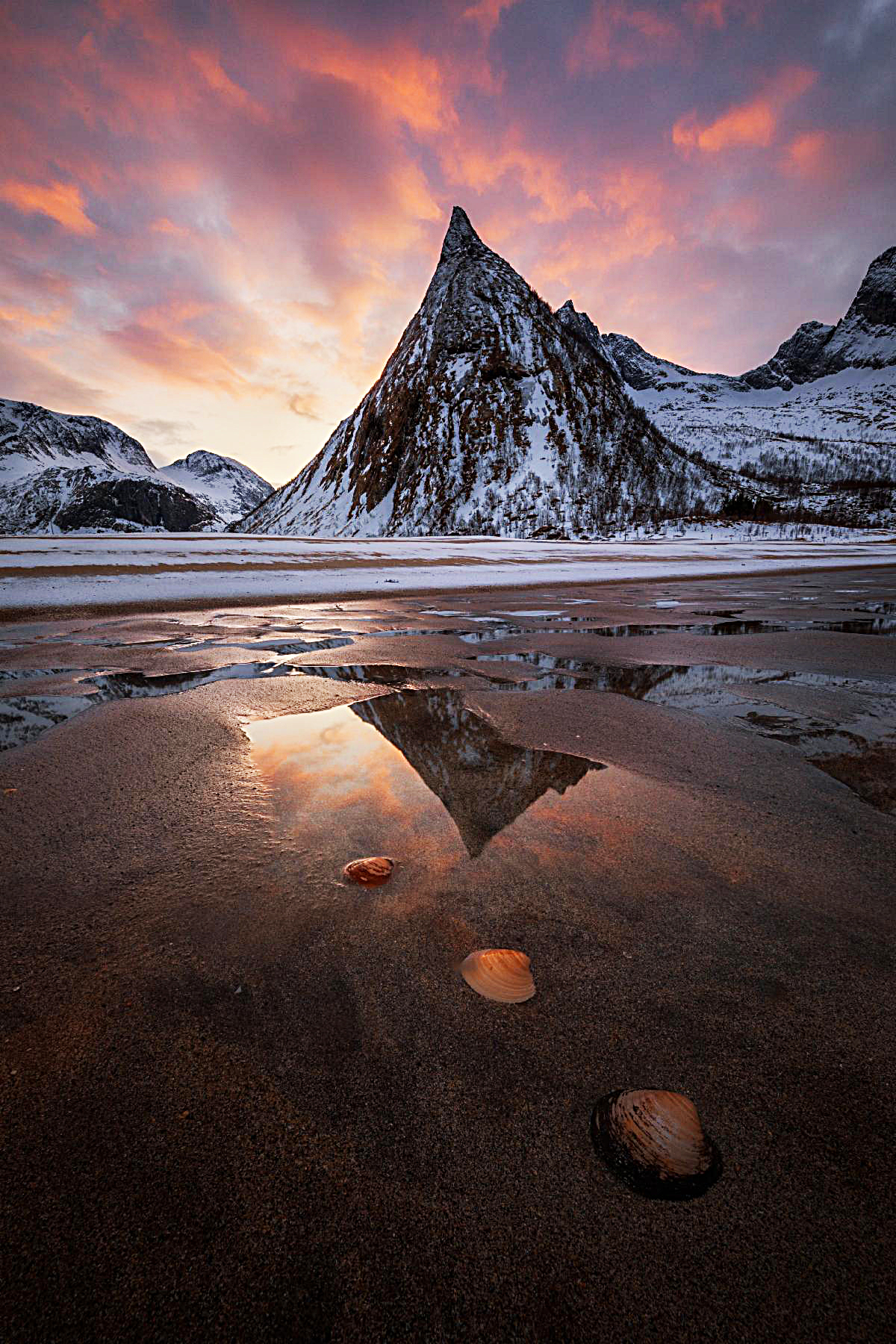
This image features the beach at Ersfjord, a stunning and well-loved spot on Senja Island. The view toward the ocean is flanked by mountains, creating a dramatic backdrop. This is the most frequently photographed view at this location. Interestingly, the view toward the main road features a mountain that resembles a witch's hat when viewed from certain angles. This teaches us an important lesson: even in well-known locations, it's worthwhile to explore your surroundings. Sometimes, the most captivating views are those that are less commonly photographed.
Low Tide Reveals More
We planned our visit for this morning, knowing it was low tide, which would likely reveal more interesting foreground elements, such as patterns in the sand. During our early February visit to Senja, the temperatures remained low and there was significant snowfall. The mountains, adorned with snow, appeared even more stunning as the melting snow formed small patches of water.
The beach is dotted with multiple patches of water reflecting the mountains, complemented by intricate sand patterns and scattered seashells that could serve as foreground elements. Standing closer to the water, I could use the wave movement as both a foreground element and a leading line. Although the scene offers plenty of options, incorporating all these elements into one frame could result in a cluttered composition. I decided to concentrate on the reflections, an irresistibly magical component in any composition that one must seize when the chance arises.
Seashells Create a Strong Leading Line
However, I needed another element that would harmonize with the overall composition, ideally a strong leading line. After inspecting several patches of water aligned with the mountain, I found no suitable sand pattern in the same frame. As time pressed on and the golden hour approached, I quickly decided to place three small seashells along a diagonal line. These shells not only enhance the leading line but also guide the viewer’s gaze directly into the mountain reflection.
Positioning the camera at the right height poses a challenge. Setting it too low enhances the reflection but obscures the leading line. Conversely, a higher position reveals the leading line but loses the reflection. Finding the perfect height for the right balance is key to achieving a strong composition.
Focus Stacking for Depth of Field
The seashells are small, necessitating a closer camera setup. Consequently, I needed to use focus stacking to ensure sharpness throughout the scene. This technique involves taking a series of images at different focus settings and then combining them to produce a final image in which everything is sharp from extremely close up to far away. There are several stand-alone applications available that assemble the multiple images into one. Some cameras also offer this technique as a built-in feature, and it can also be done in Lightroom.
After refining the composition, the day's best light arrived. Although the sun was obscured by the mountain, it illuminated and painted the clouds above. I captured several shots, each with different cloud patterns, and found that this one worked best. The clouds seemed to radiate outward from the mountain. The warm hues of the golden hour contrasted strikingly with the cool tones and wintry feel of the landscape.
Centering the Subject
Why did I place the mountain in the center of the frame instead of adhering to the rule of thirds? When aiming to highlight the magnificence, stability, and importance of the main subject, a central placement often proves more effective than an off-center one. Consider how an Olympic gold medalist stands at the center of the podium or how a throne is positioned at the heart of a throne room. The rule of thirds is not a one-size-fits-all solution; sometimes, breaking this rule better serves the image.
All the elements in this image are arranged to form a coherent and continuous path. The seashells guide the viewer's eyes toward the reflection and the main subject, the witch hat mountain. The radiating cloud pattern then directs the viewer’s gaze outward. This technique is known as “visual path” or “visual continuity,” and it helps guide the viewer’s exploration of the image.
About the Author
Kah-Wai Lin is a landscape, travel, and nature photographer based in New Jersey who has led hundreds of photo tours and workshops and has presented at over 250 seminars around the world. He was awarded First Place at the International Photography Awards in 2015 and was named one of the top 10 exhibitors in the world by the Photographic Society of America in 2015 and 2016. Lin was also honored in 2016 by being appointed as an Artist-in-Residence by the U.S. National Parks Service. In recognition of his photographic excellence and contributions to the photographic community, he was the recipient of the Certificate of Special Congressional Recognition.
Visit: Kah-Wai Lin's Website to see more of his work and learn about his workshops around the world.
Read: An in-depth interview with Kah-Wai Lin
Original Publication Date: September 29, 2024
Article Last updated: May 01, 2026
Related Posts and Information
Categories
About Photographers
Announcements
Back to Basics
Books and Videos
Cards and Calendars
Commentary
Contests
Displaying Images
Editing for Print
Events
Favorite Photo Locations
Featured Software
Free Stuff
Handy Hardware
How-To-Do-It
Imaging
Inks and Papers
Marketing Images
Monitors
Odds and Ends
Photo Gear and Services
Photo History
Photography
Printer Reviews
Printing
Printing Project Ideas
Red River Paper
Red River Paper Pro
RRP Products
Scanners and Scanning
Success on Paper
Techniques
Techniques
Tips and Tricks
Webinars
Words from the Web
Workshops and Exhibits
all
Archives
September, 2026
August, 2026
July, 2026
June, 2026
May, 2026
April, 2026
March, 2026
February, 2026
January, 2026
more archive dates
archive article list


Red River Paper Inc. All contents © 1997 - 2026. 8900 Ambassador Row, Dallas Texas, 75247. Prices, specifications, and images are subject to change without notice. Not responsible for typographical or illustrative errors. Website Terms & Conditions | Acceptable Use
Site Development & Maintenance: Phosphor Media, LLC